




The first question every client asks me when their immigration appeals case lands at the Board of Immigration Appeals is the same. How long is this going to take after the immigration judge ruled against me and the board of immigration appeals has to review it? They want a number. They want a calendar date. They want to know when they can plan their life again after an unfavorable immigration judge ruling.
I want to give them that. I really do. But the honest answer in 2026 is more complicated than it was even a year ago. The BIA appeal timeline after an immigration judge decision has been completely rewritten, partially undone by the courts, and is still in flux. So when I sit with a client, I don’t give them a single number for their immigration appeal. I give them a range, and I tell them what controls where in that range their case will land.
Let me walk you through what the appeals process actually looks like, step by step, from the day the immigration judge issues a decision to the day the Board hands down a ruling.
What’s Actually Happening in 2026
In February 2026, the Department of Justice, working through the Executive Office for immigration review and the Office of the chief immigration judge that oversees the immigration courts nationally, working with the chief immigration judge directly on systemic procedural matters. The chief immigration judge supervises immigration judge assignments across immigration courts nationally, published an Interim Final Rule that changed the BIA appeal process from top to bottom. The rule was supposed to take effect March 9, 2026. The Executive Office for immigration review wrote it. Under the new rules, the Board of Immigration Appeals, often called the BIA or simply the Board, was effectively converted from a full appellate review body into a gatekeeper that summarily dismisses most appeals.
The rule did three things that mattered for timing.
It cut the appeal deadline from 30 days to 10 calendar days for most cases. A 30-day appeal deadline survived only for specific asylum adjudications. The asylum merits adjudication carve-out applies only when the immigration judge conducted a full merits adjudication of an asylum application and did not deny it under certain statutory bars, including the one-year filing deadline. If your asylum case was denied for missing the one-year filing deadline rather than after merits adjudication, your appeal deadline drops to 10 days under the new rules, and a removal order may be issued faster than you expect.
It introduced simultaneous briefing, meaning both the appellant and the Department of Homeland Security file briefs at the same time. Department of Homeland Security attorneys typically appear through the ICE Office of the Principal Legal Advisor. Typically, within 20 days, instead of the old sequential schedule.
It moved the BIA toward a gatekeeper model under the new system that emphasizes rapid screening. The 2026 Interim Final Rule is explicit about this shift. Under the new system, many appeals are dismissed without a full review or a written explanation if they do not meet strict procedural standards.
On March 8, 2026, the day before the rule was set to take effect, a federal court vacated key provisions. The 10-day deadline is currently blocked. The automatic summary dismissal is currently blocked. The 30-day appeal deadline survives for now.
But other parts of the rule went into effect. The simultaneous briefing schedule is in place. The restrictions on extensions are in place. The elimination of automatic transcript review is in place. The litigation continues. The blocked parts could be reinstated at any time, which is why every immigration attorney I know is preparing cases as if the 10-day rule were already in effect.
Real talk: When a client asks me how long their appeal will take in 2026, I tell them the truth. I don’t know. Nobody knows. The system is in transition. What I can tell them is what each stage of the appeal after an immigration judge decision of the BIA appeals process typically looks like under the current procedures, and what controls the speed at each stage.
The Filing Stage: Day 1 to Day 30
The clock starts the day the immigration judge issues a decision in open court or, for written orders, the date on the decision. Not the date you receive it. Not the date you understood it. The date on the immigration judge’s order.
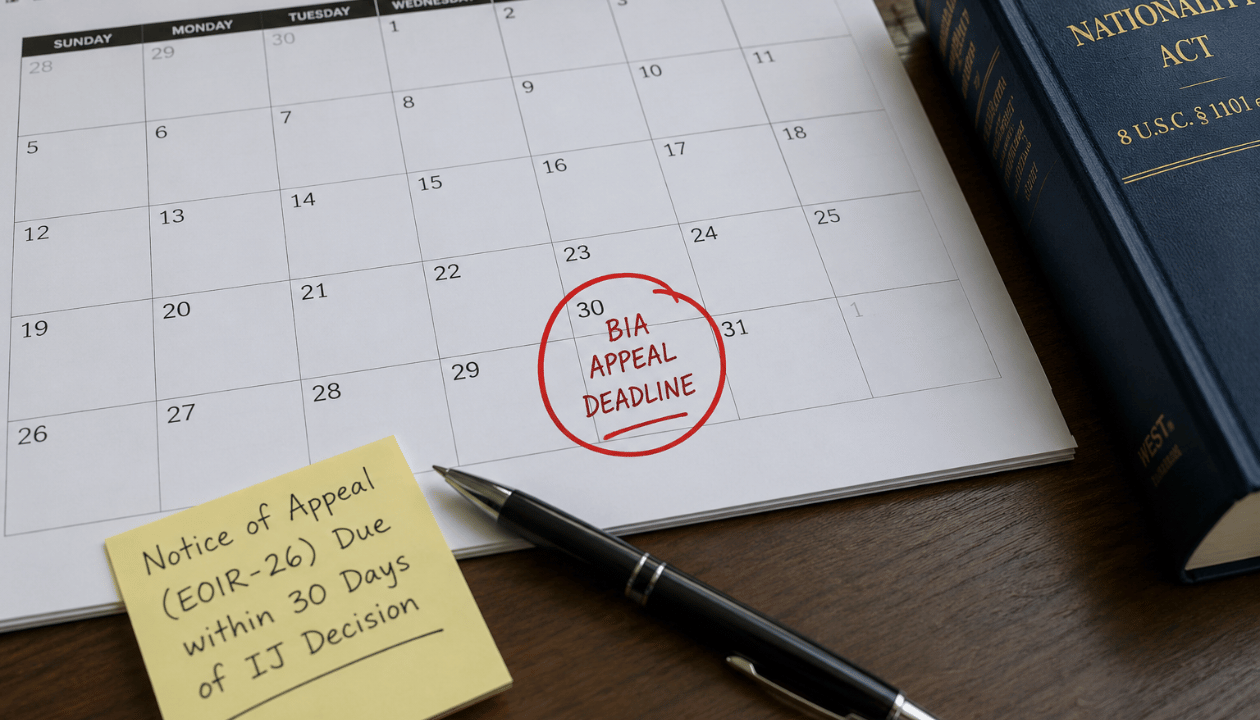
You file Form EOIR-26, the Notice of Appeal, the standardized appeal form used to begin every BIA appeal, with the BIA. As of 2026, the filing fee for a BIA appeal is $1,030. If you cannot afford it, Form EOIR-26A is a Fee Waiver Request that must be filed simultaneously with the notice of appeal.
The form arrives at the BIA office in Falls Church, Virginia. The Board in Falls Church is where every appeal of an immigration ruling in the country lands. That is where every appeal in the country goes. The BIA treats the received date as the filing date. If your notice arrives on day 31, it is dismissed as untimely. There is almost no discretion on this. The Board does not extend the filing window for late filings absent extraordinary circumstances, and even then, the bar is set very high.
Within 30 days of filing, the BIA typically acknowledges receipt of the appeal, and the immigration courts below begin preparing the record of proceedings. That includes hearing transcripts, the written decision, all evidence in the file, and any motions. The transcript preparation can take several weeks to several months. The transcript is what the Board reviews to decide whether the immigration judge applied immigration laws and nationality laws correctly. Many BIA appeals turn on whether the immigration judge properly interpreted the Immigration and Nationality Act, the regulations implementing the nationality laws, or the precedential decisions of the Board itself.
Under the rule that went into effect, the BIA will no longer review or correct the transcript of removal proceedings. That increases the risk of errors in the written record that could affect the appeal. I’m asking my clients now to keep their own notes during immigration court hearings whenever possible, because we cannot count on the transcript being corrected later.
Real talk: I had a client miss the appeal deadline by two business days last year because she received the immigration judge’s decision in the mail nine days after it was issued. That timing gap meant she had effectively three weeks, not four, to find an attorney, gather money for the filing fee, and file. We managed to get the case reopened on a different procedural ground, but the cost was 11 additional months in proceedings. Don’t assume you have 30 days. Treat every day from the immigration judge’s decision as a day you cannot afford to lose.
The Briefing Stage: Day 30 to Day 90
Once the BIA acknowledges the appeal and the transcript is prepared, you receive a scheduling order from the office of the chief appellate immigration judge that sets the briefing deadline. The chief appellate immigration judge’s office is responsible for assigning cases and setting these deadlines, and the chief appellate immigration judge has authority over how the briefing schedule is structured. This typically arrives within a few weeks for detained cases and several weeks to several months for non-detained cases.
Under the old system, the appellant filed first, the government responded 21 days later. Under the new procedures effective March 9, 2026, the briefing schedule shifted to simultaneous filing. The appellant’s brief and the Department of Homeland Security’s brief are due at the same time, typically within 20 days of the scheduling order. Both sides file blind to each other’s arguments. The new briefing schedule rewards thorough preparation.
This is a meaningful change. Under sequential briefing, I could read what the government’s principal legal advisor argued and respond directly to its points. Under the new concurrent briefing approach, I have to anticipate the assistant chief counsel’s arguments and address them preemptively. That is harder. It means the brief I file at the start of the case has to be more comprehensive, not less.
The notice of appeal itself now carries more weight than it used to. Under the new procedures, the Board has signaled that the notice of appeal must be drafted with the expectation that it may be the only meaningful advocacy seen by the Board before a decision is made. Many immigration appeals are dismissed before the traditional briefing process even begins. So the days when a one-page notice of appeal was acceptable are over. The notice now needs to identify specific legal errors, cite the record, and lay out the legal arguments the Board needs to see.
Extensions are now harder to get. Under the old rules, I could request one continuance of about three weeks for my first brief. Under the new rules, extensions require exceptional circumstances, defined narrowly. Serious illness might qualify. A heavy caseload will not. Death in the family might qualify. A vacation will not. The Board has tightened the criteria significantly.
Oral arguments are rare and granted only in a minority of cases. The vast majority of BIA appeals are decided on the written record, with the Board reviewing the brief, the transcript, and the decision below. The Board reviews questions of law fresh. When the BIA reviews the immigration judge ruling, it can substitute its own legal analysis for the immigration judge’s analysis. When the BIA reviews factual findings, but findings of fact, including credibility findings, get reversed only for clear error.
The Decision Stage: When the Board Reviews and Rules
After the briefing closes, the case goes to the Board for a decision. This is where the BIA appeal processing time really stretches out.
Most immigration appeals at the BIA are decided by three-member panels of Board members. The three-member panels review the immigration judge ruling, the record of proceedings, and the briefs filed by both sides. Single-member decisions move faster, but three-member panels are required for cases that raise novel legal questions or that the Board wants to use as precedent for other BIA appeals, though many routine cases are decided by a single Board member who acts in the place of a three-member panel and reviews the case directly. Under the new procedures, the Board can summarily dismiss appeals that fail to articulate substantive legal grounds. Common grounds for summary dismissal of BIA appeals include missing the deadline to appeal the immigration judge ruling, indicating you would file a brief but then not filing one, or filing a notice that contains only boilerplate language with no specific legal arguments.
The Board can do four things with your appeal.
It can dismiss the appeal, which makes the immigration judge’s decision final. It can sustain the appeal and reverse the immigration judge’s decision after its own merits adjudication. It can remand the case back to the immigration courts for further proceedings on a specific issue. It can affirm without opinion under streamlining procedures, which results in a brief board decision with no detailed explanation.
The appeal processing time at this stage depends on three factors. The complexity of the case. Whether the respondent is detained. And the Board’s backlog.
What the Numbers Actually Look Like in 2026
Here is what I am seeing in cases right now.
The Board of Immigration Appeals decided about 44,785 appeals filed in earlier periods in FY2024, while approximately 138,672 were still pending at year-end. By Q3 of FY2025, EOIR statistics reported over 186,000 appeals filed and pending decision. As of early 2026, the broader immigration court backlog reportedly exceeds 3.2 million cases. The Board itself has been reduced to 15 members, down from 28 in earlier years, which constrains how many cases it can process even when staff are working at full capacity.
Detained cases move faster. Much faster. A recent study found detained BIA appeals average about 145 days, roughly 4.8 months, from filing to decision. Non-detained cases average around 850 days, roughly 28 months. That gap is not a coincidence. The system is designed to prioritize a detained respondent because the cost of detention to the government is so high. When a detained alien is sitting in custody waiting for a decision, the government is paying for that bed every night. So those cases get pushed to the top of the queue.
For non-detained cases, the BIA appeal processing time can range from 6 months for the simplest cases to over two years for complex factual records. Asylum applications, cancellation of removal appeals, withholding of removal appeals based on asylum applications, and cases involving the United Nations Convention against Torture or under an asylum cooperative agreement framework protections all take longer because they require detailed review of the record. Cases that turn on a single legal issue, like the immigration consequences of certain criminal convictions, can move faster because the Board mainly analyzes statutes and case law.
Real talk: I had a non detained client whose appeal sat at the BIA for 22 months before any decision came down. During that time, his daughter graduated high school. His mother passed away. He missed two family weddings he could have attended if he had certainty about his status. That’s the reality of the BIA appeals process for non detained respondents in busy circuits. The bia appeal processing time is not just a number on a calendar. It is your life, on hold.
What This Looks Like in Real Cases
In my practice, I see patterns that come up again and again in BIA appeals.
The “I waited too long to file” pattern. A respondent loses in immigration court, panics, waits two weeks to call an attorney, and arrives at my office with 14 days left. We can still file a clean notice of appeal in that window, but I’ve lost the time I’d have used to do a deeper record review. Every day you wait after the immigration judge’s decision is a day of preparation lost. If you are going to appeal, call within the first 48 hours.
The “detained respondent transferred mid-appeal” pattern. A detained respondent gets transferred from one detention facility to another while their appeal is pending. Their original attorney can no longer reach them. The new facility may be in a different Immigration and Customs Enforcement field office region under the Department of Homeland Security. The case timeline gets disrupted. This happens more often than it should. I always tell clients to make sure family members have my contact information and the appeal docket number, so they can find me if the client is moved.
The “simultaneous briefing surprise” pattern. A client whose attorney filed under the old rules, expecting to see the government brief before responding. Under the new procedures, that does not happen. The case got decided on a brief that did not address the strongest government arguments because the attorney had not seen them yet. The case is on petition for review at a circuit court of appeals now. The lesson is that under the new concurrent briefing schedule, you cannot draft your brief reactively. You have to anticipate the arguments the government attorney will make to the immigration judge panel reviewing your appeal. The appellate court will not let you raise issues for the first time that should have been argued at the Board.
Real talk: I’m seeing more cases where the entire BIA appeals timeline collapses into 60 to 90 days because the Board summarily dismisses appeals it deems procedurally deficient. The old assumption that you had months to refine your arguments is gone. The notice of appeal and the opening brief have to be your best work the day you file them, because they may be the only thing the Board reads before deciding.
What You Should Do Next
If you are facing an unfavorable immigration judge decision right now, here is what I tell every client, in this order.
1. Calendar two deadlines, not one. Mark 10 days from the immigration judge’s decision. Then mark 30 days. Treat 10 days as your real deadline because the rule could be reinstated, and treat 30 days as your absolute outside limit. The clock from the immigration judge ruling is already running.
2. Call an immigration attorney within 48 hours. Not 48 days. 48 hours. The appeals process under the new system is so compressed and so unforgiving that the first 48 hours after a decision are when the most important strategic choices get made. Whether to appeal at all. What grounds to appeal on. What evidence to flag in the record. Which prior immigration cases provide controlling authority. These are decisions that benefit from immediate professional input.
3. Gather the appeal filing fee or apply for a fee waiver. The filing fee is $1,030 in 2026. If you cannot afford it, Form EOIR-26A is the fee waiver request. The fee waiver application must be filed simultaneously with the notice of appeal, not separately. A rejected fee waiver may give you only 15 days to cure the filing.
4. Preserve the record. Get a copy of your immigration court file. Get a copy of the immigration judge’s decision. Save every notice, every motion, every piece of evidence you submitted as supporting documents. Because the BIA no longer reviews or corrects the transcript, you may need to challenge transcript errors yourself based on your own notes and records.
5. Do not leave the country. If you have a removal order and you leave the United States while your appeal is pending, your appeal is generally considered withdrawn under the post-departure bar. You also become inadmissible. Stay put until the case is resolved by the Board or the immigration courts.
6. Stay in compliance. Maintain your current address with USCIS and the immigration court. Discrepancies in your address can lead to the immediate overturning of bond decisions in 2026 under new policies. Notify the court of any change within five days. Do not give the system any procedural reason to act faster than it already is.
FAQs
Can the Board of Immigration Appeals overturn immigration judge decisions without a new hearing?
Yes. The Board of Immigration Appeals is the highest administrative body that reviews immigration judge decisions issued by immigration courts nationwide. In many administrative appeals, the Board reviews the written record, hearing transcript, and legal arguments without holding a new hearing. The BIA may dismiss the appeal, remand the case, or reverse the immigration judge’s ruling if it finds legal errors in how immigration matters were decided.
What role does the Attorney General play in BIA appeals?
The Attorney General has authority over the Executive Office for Immigration Review and can review certain administrative decisions issued by the Board of Immigration Appeals. In rare cases, the Attorney General may certify immigration matters for personal review and issue precedential rulings that affect the existing process used in immigration courts across the country.
Is judicial review available after the BIA denies an appeal?
Yes. After the Board of Immigration Appeals issues a final decision, many respondents may seek judicial review in a federal circuit court of appeals. Judicial review allows federal judges to examine whether immigration laws, constitutional protections, or administrative procedures were applied correctly during the administrative appeals process.
How do federal immigration agencies interact during BIA appeals?
Several agencies and officials may become involved during immigration appeals. The Department of Homeland Security, the naturalization service structure that evolved into modern USCIS functions, ICE attorneys, the acting assistant director, and sometimes the acting director of certain federal immigration divisions may all participate in immigration matters connected to removal proceedings, enforcement actions, or appellate litigation before the Board.
Don’t Let the Clock Decide Your Future. Let’s Build Your Appeal Now.
The BIA appeals process is harsher and faster than it was even a year ago. The Board is dismissing more cases. The deadlines are tighter. The procedural protections that used to give attorneys time to develop arguments are mostly gone. But your appeal still matters. The immigration judge’s decision is not the end of the road, and a well-built appeal can still win.
If you just received an unfavorable decision from immigration court, if your appeal is pending and you are not sure what to expect, or if your case is heading toward a critical deadline, schedule a consultation today. I’ll review the immigration judge’s decision, identify the appeal grounds for the board of immigration appeals, and walk you through what your specific timeline looks like under the current procedures. Your future is worth the call.
📞 Call The Chidolue Law Firm today at:
➡ 678-233-2170
➡ 678-325-1037
💬 For WhatsApp inquiries, contact us at:
➡ 404-333-8751
Same-day responses on most consultations. My attorneys are licensed by the Florida Bar and the Georgia Bar. The Florida Bar license allows me to represent clients in Florida cases that affect federal immigration courts. We serve clients in all 50 states.